
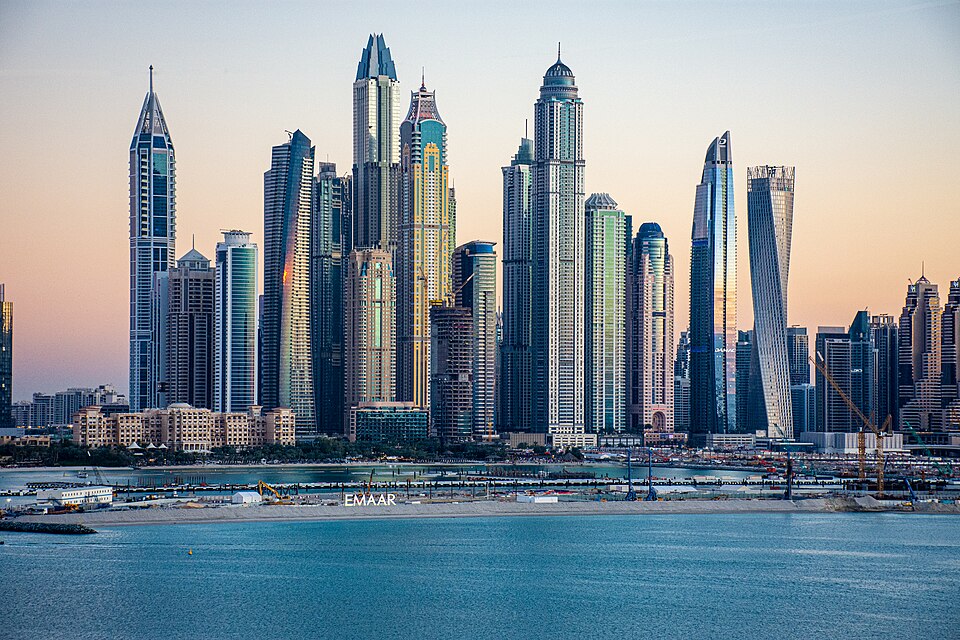
 Photo: Norlando Pobre / Wikimedia Commons, CC BY 2.0
Dubai
DXB is Dubai International. The city is also a short break for people flying in.
This Dubai travel guide is for a short break or a stopover. Dubai is one city a search can start from, not the only one, and it also works as a few days on the way somewhere else. Stay near the metro, save the outdoor sights for the morning and the evening, and keep half a day for the old town on either side of Dubai Creek. It covers the airports, getting around, where to stay, the main sights, food, day trips, and when to go.
At a glance
- Airports: Dubai International (DXB); Al Maktoum International (DWC), in Dubai South
- Time zone: Gulf Standard Time, UTC+4 all year, no daylight saving
- Currency: UAE dirham (AED)
- Language: Arabic; English is used almost everywhere
- Plugs: type G (British three-pin), 230 V
- Best months: November to March
- Trip length: two days for a stopover, four or five for the city and a day trip
Airports
Most flights use Dubai International (DXB), one of the busiest international airports in the world. Terminal 3 is Emirates’ base, Terminal 1 handles most other international airlines, and Terminal 2 serves flydubai and many regional flights. Al Maktoum International (DWC), in Dubai South, handles a smaller number of flights. Sharjah (SHJ) and Abu Dhabi (AUH) are other airports in reach by road, so a search can compare all three.
Typical non-stop flight times are about three hours from Mumbai, around three and a half hours from Delhi, about seven hours from London, and around seven and a half hours from Singapore.
Getting around
A Nol card, sold at metro stations, pays for the metro, buses, the tram, and public water transport. Eating and drinking are not allowed on the metro and in stations, and each train has a Gold Class cabin and a section for women and children.
- Red Line: stops at DXB Terminals 1 and 3 and runs along Sheikh Zayed Road past Downtown (Burj Khalifa/Dubai Mall station), Mall of the Emirates, and Dubai Marina. A branch runs to Expo City Dubai.
- Green Line: serves the older districts around the Creek, including Al Ghubaiba, Al Fahidi, and Union.
- Dubai Tram: runs through Dubai Marina and JBR and links to the Palm Jumeirah monorail.
- Abras: the wooden boats cross Dubai Creek between Deira and Bur Dubai for a small fare, paid in cash.
- Taxis and app cabs: metered taxis are easy to find, and Careem and Uber work across the city.
Areas to stay
- Downtown: next to the Burj Khalifa, Dubai Mall, and the fountain, with a Red Line station. The most central base for a first visit.
- Dubai Marina and JBR: towers around a marina, with a long public beach, restaurants, and the tram.
- Palm Jumeirah: resort hotels on the man-made island, best for a beach stay.
- Jumeirah and Umm Suqeim: low-rise beach neighbourhoods with views of the Burj Al Arab.
- Deira and Bur Dubai: older, cheaper, and close to the souks, the Creek, and the Al Fahidi historic district.
- Business Bay: along the Dubai Water Canal, a short ride from Downtown.
What to see
Downtown
- Burj Khalifa: the world’s tallest building, with observation decks on levels 124, 125, and 148. Book a timed ticket, and go near sunset for day and night views.
- The Dubai Fountain: free shows on the lake below the tower, every evening from early evening until late.
- Dubai Mall: one of the largest malls in the world, with an aquarium and an ice rink.
- Museum of the Future: the ring-shaped building on Sheikh Zayed Road, with exhibitions about the coming decades.
Old Dubai
- Al Fahidi Historical Neighbourhood: restored wind-tower houses, small museums, galleries, and cafés on the Bur Dubai side of the Creek.
- Al Shindagha Museum: the story of Dubai and the Creek, in old courtyard houses near the mouth of the Creek.
- Gold and Spice Souks: across the Creek in Deira, a short abra ride away. Haggling is normal.
- Etihad Museum: the story of the founding of the UAE in 1971, at the site where the union was signed.
The coast
Kite Beach and the public beaches of Umm Suqeim are free, with views of the Burj Al Arab. The Palm Jumeirah has the Atlantis resort at its tip, and The View at The Palm looks down over the island. In Dubai Marina, a walk along the promenade or a short boat trip shows the skyline from the water.
Art and design
Alserkal Avenue, in Al Quoz, is a cluster of galleries and studios in former warehouses. The Dubai Frame, in Zabeel Park, is a 150-metre picture frame with a glass-floored bridge between old and new Dubai. Dubai Opera, in Downtown, hosts concerts, ballet, and musicals.
The desert
Desert trips leave in the afternoon for dune drives, sandboarding, and dinner at a camp, returning late in the evening. Choose an operator that keeps to the marked desert areas and drives with care. Early-morning balloon flights and camel rides are quieter options.
Food
- Emirati dishes: machboos (spiced rice with meat or fish), harees, and luqaimat (sweet dumplings with date syrup).
- Shawarma and manakish: quick, cheap, and everywhere, especially in Deira, Satwa, and Karama.
- South Asian food: Karama, Bur Dubai, and Deira have some of the best Indian and Pakistani cooking outside the region.
- Arabic coffee and dates: served as a welcome in many hotels and homes.
- Weekend brunch: long buffet brunches are a local institution on Saturdays and Sundays.
Alcohol is served in licensed hotels, restaurants, and bars. Being drunk in public is an offence.
Day trips
- Abu Dhabi: about 90 minutes by road for the Sheikh Zayed Grand Mosque and the Louvre Abu Dhabi.
- Sharjah: next door, for museums and the restored Heart of Sharjah; allow extra time in rush-hour traffic.
- Hatta: mountains, a dam lake for kayaking, and a heritage village, about 90 minutes from the city.
Three days in Dubai
- Day 1: Al Fahidi, the Al Shindagha Museum, an abra across the Creek, and the Gold and Spice Souks; evening at the Dubai Fountain.
- Day 2: a morning on Kite Beach, the Museum of the Future, and the Burj Khalifa at sunset.
- Day 3: a desert trip in the afternoon, or Dubai Marina and the Palm with a day trip to Abu Dhabi instead.
When to go
November to March is the comfortable season, warm by day and mild in the evening, and the busiest time for events and outdoor markets. From June to September it is very hot, often above 40°C, and most of the day moves indoors. During Ramadan, which moves earlier each year, restaurants stay open, and the evenings come alive after sunset. The UAE weekend is Saturday and Sunday.
Money and entry
The currency is the UAE dirham (AED), pegged to the US dollar. Cards are accepted almost everywhere; keep a little cash for abras, souks, and small shops. Tipping of around 10% is common in restaurants if service is not included. Entry rules depend on your passport. Some nationalities get a visa on arrival and others apply before travel, so check the official UAE government portal before you book.
Etiquette and practical tips
- Swimwear is for beaches and pools; cover shoulders and knees in malls, souks, and old Dubai.
- Ask before photographing people, and do not photograph government buildings.
- Public displays of affection are frowned upon.
- Drink plenty of water and avoid long walks in the middle of the day from May to October.
Nearby
Other city notes: Abu Dhabi and Sharjah. Cities people often pair with Dubai include Mumbai and the Maldives. A sample route that ends here is Delhi to Dubai. Use the search to compare flights to DXB from your own city.
Getting around: read the Dubai Metro guide for Red and Green lines, hours, and Nol fares.
Fares are not stored on this page. Use the search to compare live prices from the providers.