
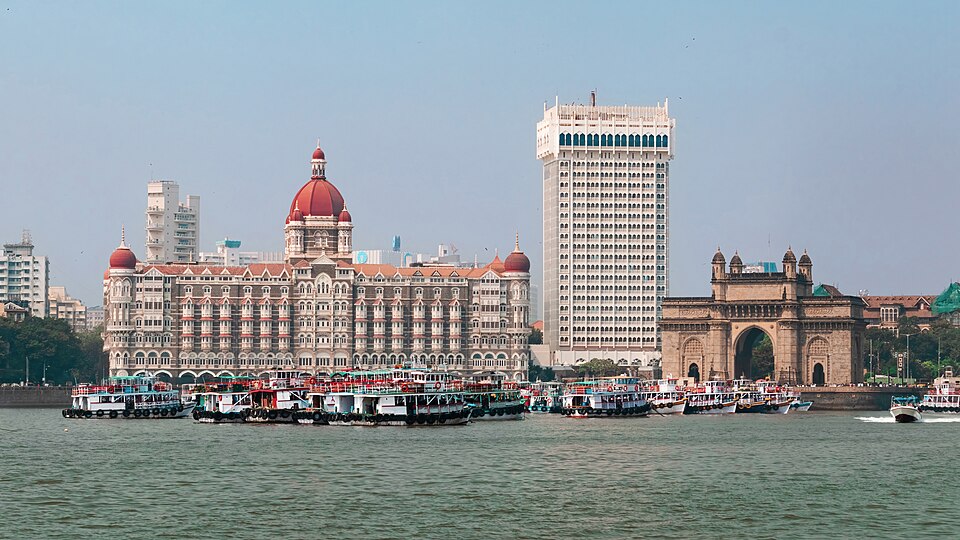
 Photo: iMahesh / Wikimedia Commons, CC BY-SA 4.0
Mumbai
The bay, the fort district, and neighbourhoods that work as a city break. The airport is BOM.
This Mumbai travel guide is about the bay, the fort district, and the neighbourhoods that work as a short city stay. Base yourself in South Mumbai for the heritage buildings and the sea front, or in Bandra for cafés and an easier airport run, and keep a morning for the ferry to the Elephanta Caves. It covers both airports, getting around, where to stay, the main sights, food, day trips, and when to go.
At a glance
- Airports: Chhatrapati Shivaji Maharaj International (BOM); Navi Mumbai International (NMI), across the harbour
- Time zone: India Standard Time, UTC+5:30 all year
- Currency: Indian rupee (INR)
- Language: Marathi and Hindi; English is widely used
- Plugs: types C, D, and M, 230 V
- Best months: November to February
- Trip length: two to three days for the city, four with day trips
Airports
Most flights use Chhatrapati Shivaji Maharaj International (BOM) in the northern suburbs; Terminal 2 handles international flights and many domestic ones. The newer Navi Mumbai International (NMI), across the harbour, handles a growing number of flights, so a search can compare both. The drive from either airport to South Mumbai can take well over an hour in traffic, although the Bandra–Worli Sea Link and the coastal road help outside rush hour.
Typical non-stop flight times are about three hours from Dubai, around five and a half hours from Singapore, and around nine and a half hours from London. Prepaid taxi counters and app cabs wait outside the terminals.
Getting around
- Suburban trains: the Western, Central, and Harbour lines are fast and cheap, but very crowded at rush hour (roughly 8 to 11 in the morning and 5 to 9 in the evening). First-class and women-only coaches are marked on the platform.
- Metro: Line 1 crosses the suburbs from Versova to Ghatkopar, and the underground Line 3 (Aqua Line) runs from Cuffe Parade in the south through Bandra Kurla Complex to the airport area.
- Taxis: the black-and-yellow taxis use the meter in South Mumbai; app cabs work across the city.
- Auto-rickshaws: only allowed in the suburbs (roughly north of Bandra and Sion), not in South Mumbai.
- On foot: Colaba, Fort, and Marine Drive are easy to walk, especially in the cooler evening.
Where to stay
- Colaba: next to the Gateway of India and the Elephanta ferries, with cafés, shops, and the Taj Mahal Palace hotel. The classic first-visit base.
- Fort and Churchgate: among the heritage buildings and close to Marine Drive and the railway termini.
- Bandra: sea-facing promenades, street art, restaurants, and nightlife, about halfway between the airport and the south.
- Juhu: a beach suburb close to the airport, popular for a short stay.
- Andheri and the airport area: practical for an early flight or a stopover.
- Bandra Kurla Complex (BKC): the business district, with large hotels and an Aqua Line station.
What to see
Colaba and Fort
- Gateway of India: the basalt arch on the harbour, built in the early 20th century, with the Taj Mahal Palace hotel across the road.
- Chhatrapati Shivaji Maharaj Terminus: one of the grandest railway stations anywhere and a UNESCO World Heritage Site, still a working station.
- The Oval Maidan: the Victorian Gothic and Art Deco buildings facing this cricket ground form another UNESCO World Heritage Site.
- Chhatrapati Shivaji Maharaj Vastu Sangrahalaya: the city’s main museum, with sculpture, miniatures, and decorative arts, in the Kala Ghoda art district.
- Kala Ghoda: galleries, cafés, and old bookshops; the Kala Ghoda Arts Festival takes over the streets each February.
Along the bay
Marine Drive curves for about three kilometres from Nariman Point to Girgaum Chowpatty, and its lights at night gave it the name Queen’s Necklace. Chowpatty beach is where families come for snacks at sunset. Further north, the Haji Ali Dargah stands on an islet reached by a causeway, best visited at low tide. Banganga Tank, in Malabar Hill, is a quiet old temple tank surrounded by shrines.
Markets and city life
Crawford Market (Mahatma Jyotiba Phule Mandai) sells fruit, spices, and household goods under a Victorian roof. Dhobi Ghat at Mahalaxmi, an open-air laundry, is best seen from the bridge next to Mahalaxmi station. Mani Bhavan, where Gandhi stayed on his visits to the city, is now a small museum. The dabbawalas, who deliver home-cooked lunches across the city, are busiest around Churchgate in the late morning.
Bandra and Juhu
Bandra Bandstand and Carter Road are sea-front promenades, with Mount Mary Basilica on the hill above. The lanes around Chapel Road are covered in murals. Juhu Beach is busy in the evening with food stalls.
The Elephanta Caves
Ferries leave from the Gateway of India for Elephanta Island, about an hour across the harbour. The rock-cut temples, with the huge three-headed Shiva sculpture, are a UNESCO World Heritage Site. The caves are closed on Mondays, and ferries stop in rough monsoon weather. Allow half a day, and expect a climb of around 120 steps from the jetty.
Food
- Vada pav: a spiced potato fritter in a bun, the city’s everyday snack.
- Pav bhaji: buttery mashed vegetable curry with soft bread rolls.
- Bhel puri and pani puri: the classic beach snacks at Chowpatty and Juhu.
- Irani cafés: old Parsi-run cafés serving bun maska, berry pulao, and sweet chai.
- Seafood: Konkani and Malvani fish curries, bombil (Bombay duck) fry, and prawns.
- Cutting chai and kulfi: half-glass street tea and dense Indian ice cream.
Choose busy stalls where food is cooked fresh, and drink bottled or filtered water.
Day trips
- Kanheri Caves: more than a hundred Buddhist caves inside Sanjay Gandhi National Park in the northern suburbs. The park is closed on Mondays.
- Alibaug: beaches and old forts south of the city, by ferry from the Gateway of India and a short road connection.
- Lonavala and the Karla Caves: hill country and early Buddhist caves on the road and railway to Pune, about two to three hours away.
Three days in Mumbai
- Day 1: Gateway of India, Colaba, Kala Ghoda, and the Fort district; sunset on Marine Drive and snacks at Chowpatty.
- Day 2: ferry to the Elephanta Caves (not on a Monday) in the morning; Crawford Market and Chhatrapati Shivaji Maharaj Terminus in the afternoon.
- Day 3: Haji Ali, Banganga Tank, and Dhobi Ghat, then Bandra for the promenade and dinner.
When to go
November to February is the most comfortable time, warm and dry with cooler evenings. March to May gets hot and humid. The monsoon, roughly June to September, brings very heavy rain that can flood streets and delay trains and flights. Ganesh Chaturthi, in August or September, fills the city with processions for about ten days, and Diwali falls in October or November.
Money and entry
The currency is the Indian rupee (INR). Cards are accepted in hotels, malls, and most restaurants; carry cash for taxis, markets, and street food. Most foreign visitors need a visa, and many can apply online for an e-Visa through the official Indian visa site. Only use that official site; look-alike sites charge extra.
Etiquette and practical tips
- Dress modestly at temples, mosques, and dargahs; remove your shoes where asked.
- Avoid suburban trains at rush hour with luggage, and stand near the door only when your stop is next.
- A tip of about 10% is usual in sit-down restaurants if service is not already included.
- Allow plenty of time to reach the airport; traffic can double a journey at peak hours.
Nearby
See Dubai as one city people pair with Mumbai, Kochi for Kerala, and Delhi for the north. A longer family trip across India is India with the family. Search from any departure city.
Fares are not stored on this page. Use the search to compare live prices from the providers.