
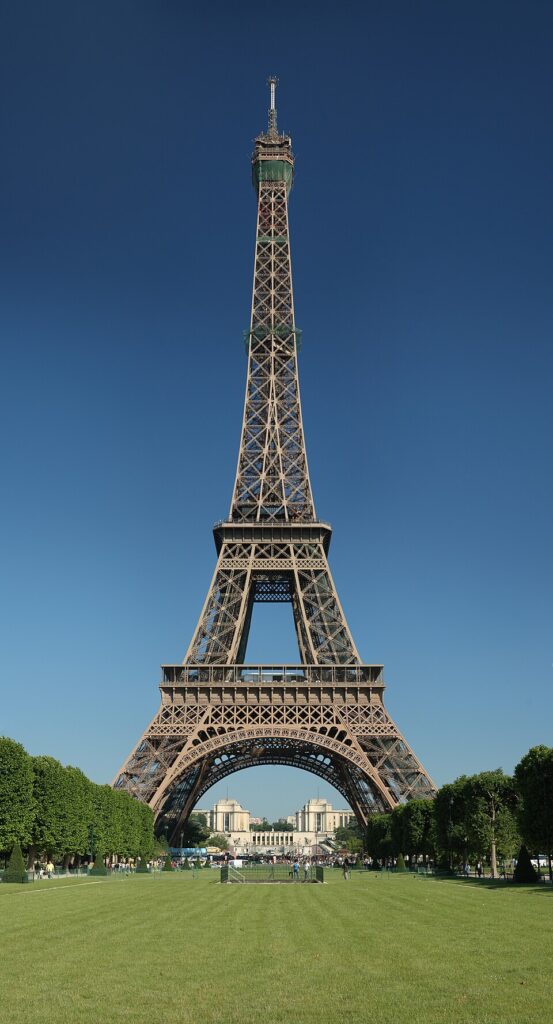
 Photo: Benh LIEU SONG / Wikimedia Commons, public domain
Paris
A compact city for a long weekend. The usual airport is CDG.
This Paris travel guide is for a long weekend or a week on foot. Pick one bank of the river for your hotel so you are not crossing the city for every meal, then give each day one area. It covers the airports, the metro, which arrondissement to stay in, the big museums and their closing days, food, day trips such as Versailles, and entry rules.
At a glance
- Airports: Charles de Gaulle (CDG), Orly (ORY), and Beauvais (BVA) for some low-cost flights
- Time zone: CET (UTC+1), CEST (UTC+2) from late March to late October
- Currency: euro (EUR)
- Language: French; English is common in hotels and museums
- Plugs: types C and E, 230 V
- Best months: April to June and September to October
- Trip length: three to four days for the highlights, a week with day trips
Airports and getting into town
- Charles de Gaulle (CDG): the main international airport, northeast of the city. RER B trains run to Gare du Nord, Châtelet, and Saint-Michel in about 35 to 50 minutes. Taxis charge a fixed fare to the right or left bank.
- Orly (ORY): south of the city. Metro line 14 now runs from Orly into central Paris, and taxis also have a fixed fare.
- Beauvais (BVA): about 85 km north, used by some low-cost airlines. A shuttle bus runs to Porte Maillot; allow at least 75 minutes.
Paris is also on the high-speed rail network: Eurostar trains from London arrive at Gare du Nord.
Getting around
The metro is dense, and most central stations are only a few minutes’ walk apart. Buy tickets on the Bonjour RATP app or on a Navigo Easy card at station machines; paper tickets are being phased out. A weekly Navigo pass runs from Monday to Sunday, so it suits a week-long stay starting early in the week. The RER lines are faster for longer trips, such as to the airports or Versailles. Vélib’ shared bikes and the riverside paths are a pleasant way to cross the centre. Watch for pickpockets on crowded metro lines, especially line 1 and around the big sights.
Where to stay
Paris is divided into 20 numbered arrondissements spiralling out from the centre.
- Le Marais (3rd and 4th): medieval lanes, boutiques, galleries, and falafel on Rue des Rosiers; central and lively.
- Saint-Germain-des-Prés (6th): classic cafés, bookshops, and the Luxembourg Gardens on the left bank.
- Latin Quarter (5th): student streets around the Sorbonne, close to Notre-Dame.
- Around the Louvre and Opéra (1st, 2nd, 9th): central and well connected, with department stores and covered passages.
- 7th: quiet and elegant, near the Eiffel Tower and the Musée d’Orsay.
- Montmartre (18th): a village feel on the hill below Sacré-Cœur, with steep streets.
- Canal Saint-Martin (10th and 11th): bars, bistros, and a younger crowd.
What to see
Museums
- The Louvre: the Mona Lisa, the Venus de Milo, and much more. Closed on Tuesdays. Book a timed ticket.
- Musée d’Orsay: Impressionist paintings in a former railway station. Closed on Mondays.
- Musée de l’Orangerie: Monet’s water lilies in two oval rooms. Closed on Tuesdays.
- Musée Rodin: sculptures in a house and garden in the 7th.
- Centre Pompidou: the modern art museum is closed for a long renovation, expected to last until about 2030.
National museums are free for EU residents under 26, and the Paris Museum Pass covers dozens of sights for two, four, or six days.
Landmarks
- Eiffel Tower: book a lift or stairs ticket ahead; the view from Trocadéro across the river is free.
- Notre-Dame: reopened in December 2024 after the 2019 fire; entry to the cathedral is free, and booking a time slot online saves queuing.
- Sainte-Chapelle: a 13th-century chapel with walls of stained glass, on the Île de la Cité.
- Arc de Triomphe: climb to the roof for the view down the Champs-Élysées.
- Sacré-Cœur and Montmartre: the white basilica on the hill, the artists’ square at Place du Tertre, and views over the city.
- The Seine: walk the quays from the Louvre to Notre-Dame, or take an hour-long river cruise.
Parks and gardens
The Luxembourg Gardens, the Tuileries between the Louvre and Place de la Concorde, and the Jardin des Plantes are all in the centre. Parc des Buttes-Chaumont in the 19th has hills, a lake, and a temple on a cliff.
Food
Start the day with a croissant or pain au chocolat from a neighbourhood bakery. Lunch menus (formule) in bistros are often the best value of the day. Try a croque-monsieur, steak frites, duck confit, French onion soup, and crêpes, and pick up cheese, bread, and fruit at a market such as Marché des Enfants Rouges in the Marais for a picnic by the river. Service is included in the bill by law; leaving a few euros for good service is a kind gesture but not expected. Many small restaurants close on Sundays, Mondays, or for part of August.
Day trips
- Versailles: the palace, the Hall of Mirrors, and the gardens, about 40 minutes on the RER C. The palace is closed on Mondays.
- Giverny: Monet’s house and garden, open from spring to autumn, by train to Vernon and a shuttle.
- Reims: champagne cellars and a Gothic cathedral, about 45 minutes by high-speed train.
- Disneyland Paris: on the RER A at Marne-la-Vallée.
- Mont-Saint-Michel: possible as a very long day trip, better with a night in Normandy.
Four days in Paris
- Day 1: Notre-Dame, Sainte-Chapelle, the Latin Quarter, and an evening river cruise.
- Day 2: the Louvre (not on a Tuesday), the Tuileries, and the Champs-Élysées to the Arc de Triomphe.
- Day 3: the Musée d’Orsay (not on a Monday), Saint-Germain, the Luxembourg Gardens, and the Eiffel Tower at dusk.
- Day 4: Montmartre and Sacré-Cœur in the morning, the Marais in the afternoon. Or Versailles, avoiding Mondays.
When to go
April to June and September to October are the most pleasant, with mild weather and long evenings. July and August are hot and busy with visitors, while many Parisians leave and some restaurants close. December has Christmas lights and markets; January and February are cold, grey, and the cheapest time for hotels. Rain is possible in any month.
Entry
France is in the Schengen area. Whether you need a visa depends on your passport, so check the official France-Visas site. The EU’s Entry/Exit System now records non-EU visitors’ fingerprints and a photo at the border on their first entry, so allow extra time at passport control.
Practical tips
- Say “bonjour” when you enter a shop or café; it matters to Parisians.
- Tap water is safe, and you can ask for a free jug (une carafe d’eau) in restaurants.
- Most shops close or open shorter hours on Sundays, except in tourist zones such as the Marais and the Champs-Élysées.
- Book the Louvre, the Eiffel Tower, and Sainte-Chapelle online ahead of time.
Plan the trip
See the Paris long weekend. A flight can be direct or with a stop, depending on the city you leave from. Use the search to compare flights to CDG or ORY.
Fares are not stored on this page. Use the search to compare live prices from the providers.