
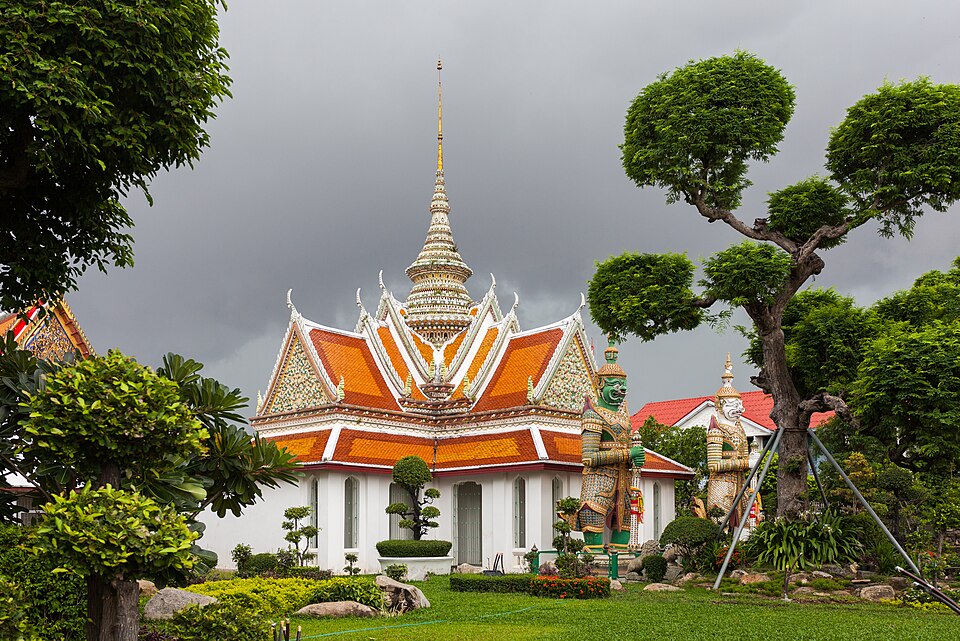
 Photo: Diego Delso / Wikimedia Commons, CC BY-SA 3.0
Bangkok
The river, neighbourhood food, and day trips toward the coast. The airport is BKK.
This Bangkok travel guide covers the river, neighbourhood food, and day trips toward the coast and the old capital. River boats and the Skytrain are the simple way to move, and a trip of four days or more leaves room to get out of the city. It covers both airports, transport, where to stay, temples and markets, street food, day trips, seasons, and entry rules.
At a glance
- Airports: Suvarnabhumi (BKK) for most international flights; Don Mueang (DMK) for many low-cost airlines
- Time zone: UTC+7, no daylight saving
- Currency: Thai baht (THB)
- Language: Thai; English is common in hotels and central areas
- Plugs: types A, B, C, and O, 220 V
- Best months: November to February, the cool, dry season
- Trip length: three days for the city, five or more with day trips
Airports and getting into town
- Suvarnabhumi (BKK): about 30 km east of the centre. The Airport Rail Link runs to Makkasan and Phaya Thai, where it connects with the MRT and the BTS Skytrain. Metered taxis leave from the official rank on the ground floor; the airport and expressway fees are added to the meter.
- Don Mueang (DMK): north of the city. The SRT Red Line runs from Don Mueang station to Krung Thep Aphiwat Central Terminal, which connects with the MRT. Taxis and airport buses also run into town.
Check which airport your flight uses, especially for onward flights within Asia; transfers between BKK and DMK take an hour or more.
Getting around
- BTS Skytrain and MRT: the quickest way across the city, with air-conditioned trains that skip the traffic. Many stations accept contactless bank cards.
- Chao Phraya Express Boat: the river boats stop at piers near the Grand Palace, Wat Pho, Wat Arun (by cross-river ferry), Chinatown, and the riverside hotels. The orange-flag boat stops at most piers. Sathorn pier connects with Saphan Taksin BTS station.
- Khlong boats: fast canal boats on Khlong Saen Saep cross the city east to west, used mostly by commuters.
- Taxis and apps: insist on the meter, or use Grab or Bolt for an agreed price.
- Tuk-tuks: fun for a short ride; agree the price first, and decline any offer of a cheap “tour” that stops at gem or tailor shops.
Where to stay
- Riverside: hotels along the Chao Phraya with boat access to the temples, and river views at night.
- Old Town (Rattanakosin) and Banglamphu: walking distance to the Grand Palace and Wat Pho; Khao San Road for backpacker nightlife.
- Sukhumvit: a long road with hotels at every level, restaurants, and nightlife, along the BTS line.
- Silom and Sathorn: the business district, near Lumphini Park and night markets.
- Siam and Ratchathewi: shopping malls and good BTS connections.
- Chinatown (Yaowarat): street food, gold shops, and old shophouses, with an MRT station.
What to see
Temples and palaces
- The Grand Palace and Wat Phra Kaew: the former royal palace and the Temple of the Emerald Buddha. A strict dress code applies: covered shoulders and knees, no see-through clothing. Ignore anyone outside who says it is closed today; it is a common scam.
- Wat Pho: the giant Reclining Buddha, and a respected school of traditional Thai massage on site.
- Wat Arun: the Temple of Dawn, across the river by a short ferry. Climb its steep steps by day, and view it lit up from the east bank at night.
- Wat Saket (the Golden Mount): a temple on a hill with a wide city view.
Markets
- Chatuchak Weekend Market: thousands of stalls, open on Saturdays and Sundays. Go in the morning before the heat.
- Chinatown at night: Yaowarat Road fills with street-food stalls after dark.
- Pak Khlong Talat: the flower market, busiest late at night and early in the morning.
- Talat Noi: old riverside lanes with street art and cafés, next to Chinatown.
More of the city
Jim Thompson House is a traditional teak house and garden museum. Lumphini Park is the green lung of the centre, with monitor lizards around the lake. ICONSIAM, on the river, is a huge mall with an indoor floating market. Rooftop bars in Silom and Sathorn give the skyline view after dark.
Food
Bangkok is one of the world’s great street-food cities. Try pad thai, tom yum goong (hot-and-sour prawn soup), som tam (green papaya salad), khao man gai (Hainanese chicken rice), pad kra pao (stir-fried holy basil with chilli), boat noodles, and mango sticky rice. Busy stalls with high turnover are a good sign. For a sit-down meal, food courts in malls are clean, cheap, and air-conditioned. Tipping is not expected at street stalls; rounding up or leaving small change in restaurants is appreciated.
Day trips
- Ayutthaya: the old royal capital and a UNESCO World Heritage Site, with temple ruins about 80 km north. Go by train from Krung Thep Aphiwat or Hua Lamphong, or by minivan, and cycle between the ruins.
- Damnoen Saduak floating market: boats piled with fruit and food, best very early in the morning; often combined with the Maeklong railway market, where stalls fold away as the train passes.
- Kanchanaburi: the Bridge over the River Kwai, war cemeteries, and Erawan Falls further on; a long day or an overnight trip.
- The coast: Pattaya and Hua Hin are the nearest beach towns, about two to three hours away by road; Hua Hin also has a train. A day at the coast pays off only if the trip is longer than a weekend.
Four days in Bangkok
- Day 1: the Grand Palace, Wat Pho, and the ferry to Wat Arun; dinner by the river.
- Day 2: Jim Thompson House and Siam in the morning; Chinatown and Talat Noi in the evening.
- Day 3: Chatuchak (at the weekend) or Lumphini Park and a Thai cooking class; a rooftop bar at night.
- Day 4: day trip to Ayutthaya, or the floating and railway markets.
When to go
November to February is the cool, dry season and the most comfortable time, though it is still warm (around 25 to 32°C) and the busiest for visitors. March to May is the hot season, often reaching the high 30s. June to October is the rainy season: short, heavy downpours most afternoons, with lower hotel rates and fewer crowds. Songkran, the Thai New Year water festival in mid-April, turns the streets into a giant water fight for several days.
Money and entry
The currency is the Thai baht (THB). Cards work in malls, hotels, and larger restaurants; street food, markets, and taxis are mostly cash. ATMs are everywhere, though foreign cards usually pay a fixed withdrawal fee, so take out larger amounts less often.
Many nationalities can visit without a visa for a set period, and others apply through the official Thai e-Visa site. All foreign visitors must complete the online Thailand Digital Arrival Card (TDAC) in the days before arrival. Rules change, so check them shortly before you travel.
Etiquette and practical tips
- Respect the monarchy. Criticising the royal family is a serious crime, and people stand for the royal anthem before films.
- Take shoes off before entering temples and homes. Do not touch anyone’s head or point your feet at people or Buddha images.
- Women should not touch monks or hand items to them directly.
- Do not drink tap water; bottled and filtered water is everywhere.
- The heat is intense: plan temples for the morning, malls or a massage for midday, and markets in the evening.
Plan the trip
The short version is the Bangkok city break. Use the search to compare flights to BKK or DMK from your own city.
Fares are not stored on this page. Use the search to compare live prices from the providers.