
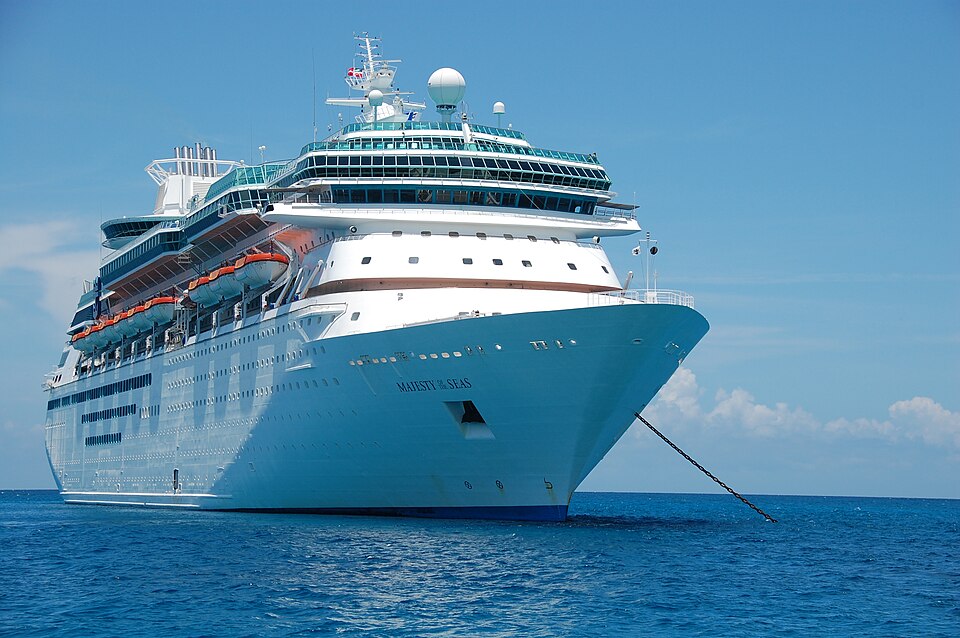
 Photo: Penny Higgins / Wikimedia Commons, CC BY-SA 2.0
Mediterranean fly-cruise notes
Fly to Barcelona, Rome, or Athens and join a ship for a week of Riviera, Italian, and Greek island ports.
These Mediterranean fly cruise notes cover a common pattern: fly to a European port and join a ship for a week in the western or eastern Mediterranean. Barcelona, Rome, the French and Italian Rivieras, and the Greek islands show up often on those routes. Below are the main starting ports and how to reach them from the airport, a typical week, the best ports and what to see, the season, entry rules, and how to plan the flight. The guide does not name a ship, a sailing date, or a cabin price.
At a glance
- Common starting ports: Barcelona, Civitavecchia (Rome), Genoa, Marseille, Palma, Piraeus (Athens), Trieste, and Ravenna for the Venice area
- Fly into: Barcelona (BCN), Rome Fiumicino (FCO), Marseille (MRS), Genoa (GOA), Palma (PMI), Athens (ATH), Venice (VCE)
- Typical length: 7 nights; 10 to 14 nights for longer routes
- Season: mainly April to October
- Best for: seeing several famous cities in one trip without repacking
Who this cruise suits
A Mediterranean fly cruise suits travellers who want a taste of several countries, such as Spain, France, Italy, Greece, Croatia, and Malta, in one week. Days are full: most ships arrive in the morning and leave in the late afternoon or evening. It suits couples, families, and older travellers who prefer not to change hotels. If you want to explore one city in depth, a city break works better.
Where ships start
- Barcelona: one of the busiest cruise ports in Europe. The terminals are near the end of La Rambla, roughly 20 to 30 minutes by taxi from Barcelona airport (BCN).
- Civitavecchia (for Rome): about 80 km from Rome. Trains from Roma Termini and Roma San Pietro take about an hour or more; transfers run from Fiumicino (FCO), about an hour away by road.
- Genoa and Savona: on the Italian Riviera, reachable from Genoa (GOA), Milan, or Nice airports.
- Marseille: about 30 to 40 minutes from Marseille Provence airport (MRS).
- Palma de Mallorca: close to Palma airport (PMI).
- Piraeus (for Athens): Athens airport (ATH) is about an hour away; the metro also links Piraeus with central Athens.
- The Venice area: large cruise ships no longer sail through the Giudecca Canal in central Venice. Most now use Trieste, Ravenna, or Monfalcone instead, with transfers to Venice.
A typical western Mediterranean week
Routes vary, but a classic week from Barcelona often looks like this:
- Day 1: board in Barcelona.
- Day 2: Marseille, for Provence.
- Day 3: Genoa or La Spezia, for the Cinque Terre.
- Day 4: Civitavecchia, for Rome.
- Day 5: Naples, for Pompeii and the Amalfi Coast.
- Day 6: a day at sea.
- Day 7: Palma de Mallorca.
- Day 8: back in Barcelona.
Eastern Mediterranean routes, often from Piraeus, Trieste, or Ravenna, combine Greek islands such as Santorini and Mykonos with Dubrovnik in Croatia, Kotor in Montenegro, or Kuşadası in Türkiye for Ephesus.
Ports and what to see
Rome (Civitavecchia)
The Colosseum and Roman Forum, the Vatican Museums and St Peter’s Basilica, and the Trevi Fountain. A day is tight: choose either ancient Rome or the Vatican, and allow time for the train back. See the route London to Rome if you want to add a few nights in the city.
Naples
Pompeii and Herculaneum, the ruins buried by Vesuvius, or a drive along the Amalfi Coast to Positano and Sorrento. Naples itself is the home of pizza.
Livorno, La Spezia, and Genoa
Livorno is the port for Florence (about 1.5 hours away) and Pisa. La Spezia is the closest port to the Cinque Terre villages. Genoa has a large historic centre and an aquarium.
Marseille and Villefranche
Marseille has its Old Port and Notre-Dame de la Garde basilica, with Aix-en-Provence nearby. Villefranche-sur-Mer is a tender port for Nice, Èze, and Monaco.
Palma and Valletta
Palma has a Gothic cathedral and old town by the sea. Valletta in Malta is a walled UNESCO city with a dramatic harbour entrance at dawn.
Greek islands and the Adriatic
Santorini (a tender port, with a cable car up the cliff to Fira), Mykonos’s windmills and lanes, Dubrovnik’s city walls, and the Bay of Kotor, one of the most scenic sail-ins in Europe.
Excursions or independent?
Ship excursions cost more but the ship waits if a tour runs late. On your own, you save money and choose the pace, but the ship will not wait if you miss the all-aboard time. For distant sights such as Rome, Florence, and Pompeii, many first-time cruisers book through the ship or a reputable operator with a return-on-time guarantee. Tender ports, where small boats take guests ashore, can add queues in the morning.
When to go
The main season runs from about April to October. Spring and early autumn are warm, with fewer crowds and lower prices than July and August, when popular ports are very busy and hot. A few ships sail in winter on shorter routes, with cooler weather and quieter ports.
The flight
The flight is a separate search from the cruise, from any city you choose. Fly in at least a day before the ship sails; a night in the port city takes the stress out of a delayed flight. If the cruise ends in a different port from where it started, book an open-jaw ticket: into one airport, home from another. On the last morning, disembarkation usually finishes by mid-morning, so choose a flight home from around midday onwards.
Entry
Most western Mediterranean ports are in the Schengen area (Spain, France, Italy, Malta, Greece, and Croatia), so one set of entry rules usually covers the trip. The EU’s Entry/Exit System records non-EU visitors’ fingerprints and photo at the first Schengen border. Montenegro, Albania, and Türkiye are outside Schengen and have their own rules. Check what applies to your passport before you book, for example on the official France-Visas site for Schengen.
What is included and what costs extra
Fares usually include the cabin, main restaurants, buffet, and entertainment. Drinks, speciality dining, Wi-Fi, excursions, gratuities, and sometimes port taxes are extra. Some lines sell all-inclusive fares; compare what each one covers.
What to pack
- Comfortable walking shoes for long port days on cobbles
- Clothes that cover shoulders and knees for churches, including St Peter’s
- A light jacket for evenings at sea and for spring or autumn sailings
- A small day bag and a refillable water bottle
- A type C plug adapter (Italy also uses type L)
Before you book
- Check the starting and ending ports and plan flights for the day before sailing.
- Look at how long the ship stays in each port, especially Rome and Florence.
- Check Schengen and non-Schengen entry rules for every country.
- Book popular excursions and Vatican or Colosseum tickets early.
Other cruise guides
Compare that flight on the homepage. Other cruise guides: Arabian Gulf cruise notes and Indian Ocean cruise notes.
Cabin prices are not listed on this page. Use the search to compare the flight to the port.